The Diamond and Gemstone Buying Kit
Buy a diamond or gemstone piece on the numbers: read the lab report, turn carats into millimeters, find the weight a deep cut hides, spend where it shows, compare quotes per face-up carat, and fit the ring and the chain
JewelryStorm's Diamond 4Cs Guide says carat is weight, not size, and that a deep cut hides weight below the girdle, but nothing on the site says how much. Its Gemstone Carat Calculator turns a stone's millimeters into carats with the jewelers' round factor and a typical 61% depth; run it backwards and it answers the question a buyer actually has: how big will this stone look? The kit does that for every stone on your list. Two round diamonds can both be graded 1.00 ct: one cut 60.9% deep measures 6.45 mm across, the other, cut 65.9% deep, measures 6.30 mm and faces up like a 0.93 ct stone, with 7.0% of its weight where nobody sees it. A well-cut 0.91 ct stone measures 6.26 mm, only 0.04 mm less. From there it sets the spending order (cut, then color for the metal, then clarity to your own eye), compares quotes per face-up carat within a budget, sizes the ring from three readings, and converts chain lengths before you compare (a 45 cm chain is 7.2 mm shorter than 18 in). The GIA scales are quoted exactly and the kit says grading differs between labs; laboratory-grown diamonds are described as diamonds, with the FTC's disclosure terms; birthstone lists are said to differ. The stones and quotes in it are examples, not market prices, and it is never an appraisal or investment advice. Necklaces are not for babies or young children. Included: 24 printable pages with a stone comparison sheet, the questions for the jeweler, a fit card, a size-to-weight table for eleven gems and a birthstone wear table, plus a personalised sheet worked from the figures you enter in our calculators.
Look inside
Two full pages from the kit, exactly as printed. Click either to read it at full size before you decide.
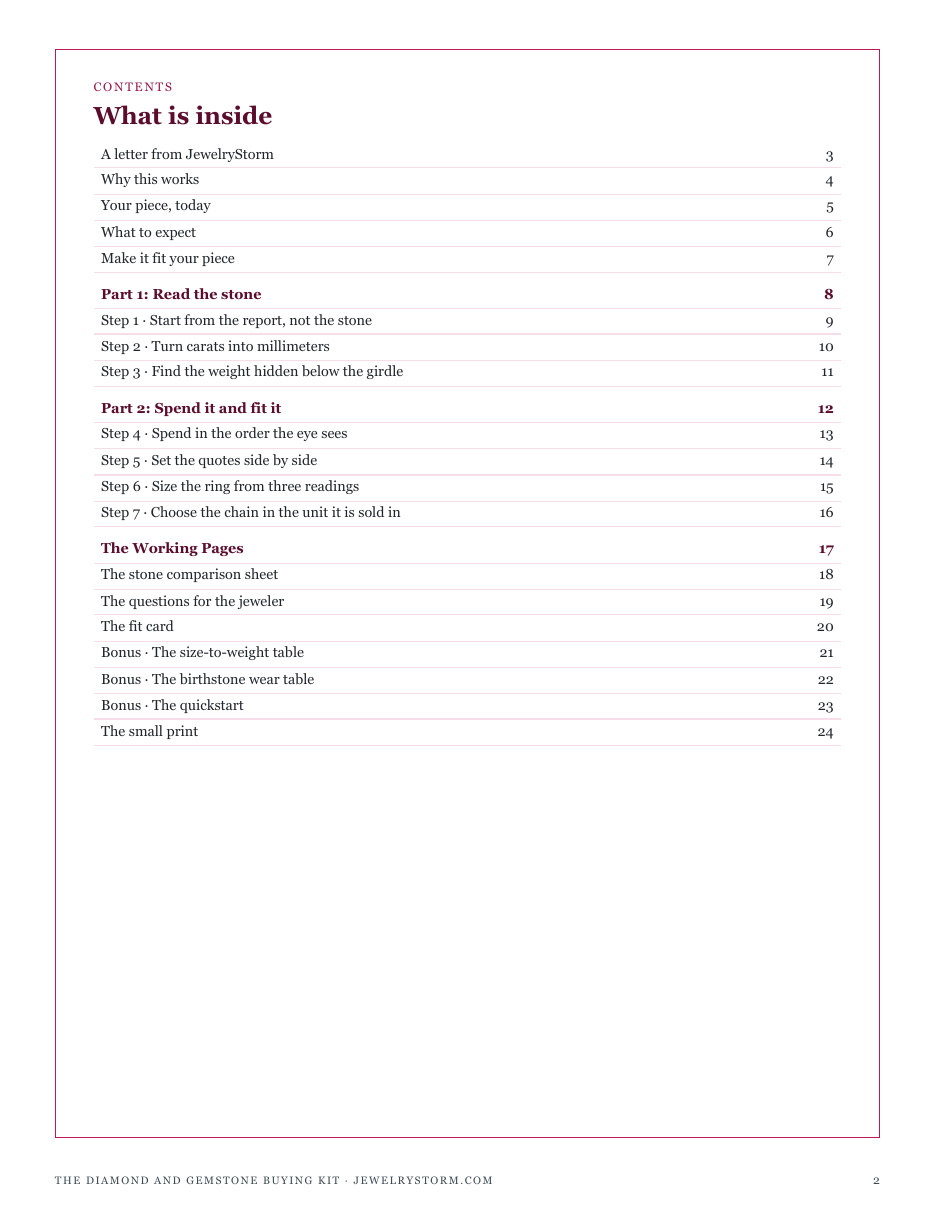
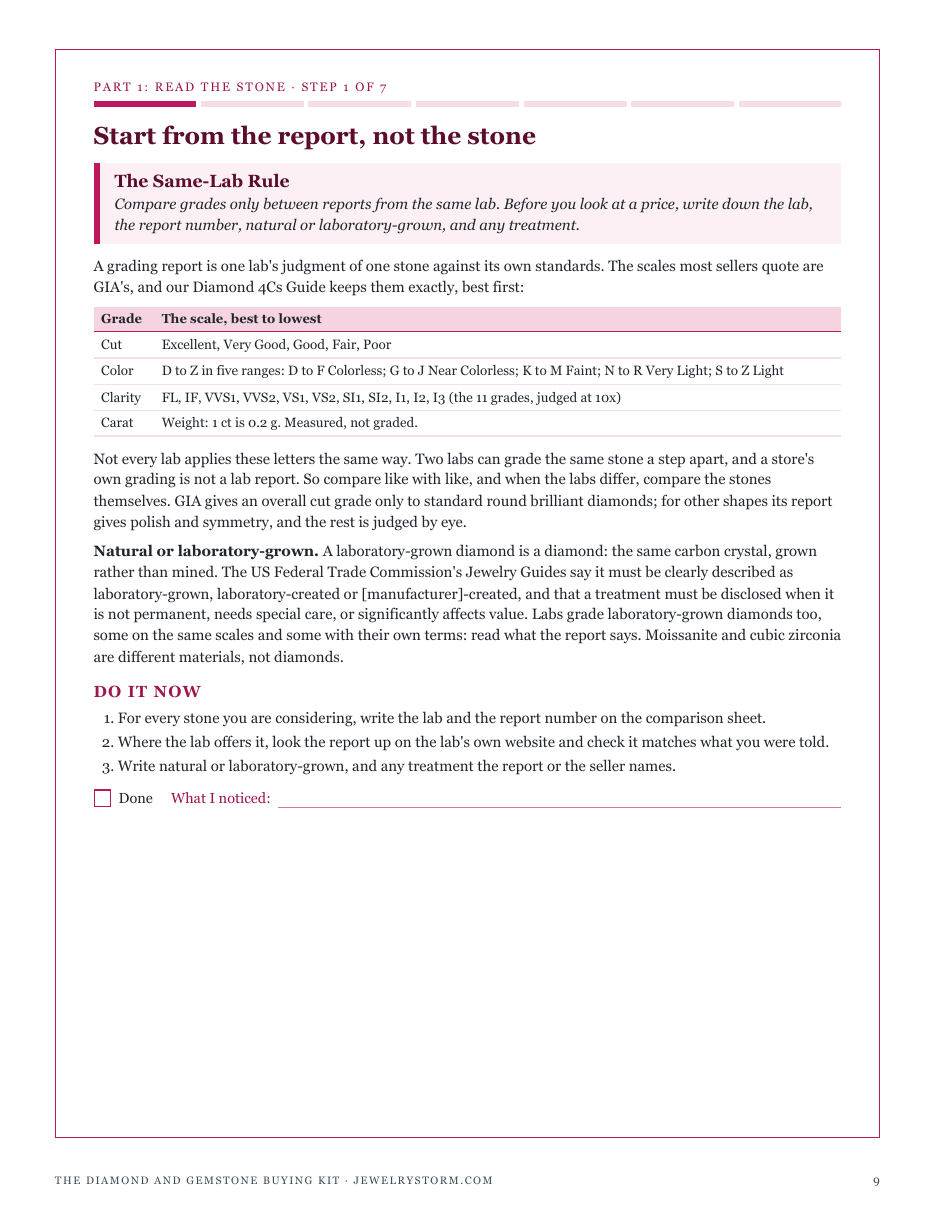
What is in it
- The Same-Lab Rule: read the report first, the GIA scales exactly, natural or laboratory-grown, and treatments
- The Millimeter Rule: every carat weight from 0.25 to 2.00 ct as a face diameter and face area
- The Spread Rule: total depth and the weight a deep cut hides below the girdle
- The Cut-First Rule: spend in the order the eye sees, cut, then color for the metal, then clarity
- The Face-Up Price Rule: quotes compared per report carat and per face-up carat, within a budget
- The Three-Reading Rule: a ring size from three readings, the knuckle, band width and resizing
- The Centimeter Rule: chain lengths sold as the same that are not, the pendant drop, and child safety
- Three working pages: a stone comparison sheet, the questions for the jeweler, and a fit card
- A size-to-weight table for eleven gems and a birthstone wear table with Mohs hardness and care notes
- A personalised sheet worked from the figures you enter in the 4Cs, carat, ring size, necklace and birthstone tools
- ✓ 24 printable pages
- ✓ 10 sections, worksheets and templates
- ✓ A second PDF worked out from the numbers you enter
- ✓ No account needed, just an email address
- ✓ Instant download; link valid 7 days
Price includes any taxes. Sold by GrabURL, who handle checkout and support. The charge appears on your statement as GrabURL.
The kit picks up where the free Diamond 4Cs Guide leaves off. The guide explains the GIA scales and says carat is weight, not size; the kit uses the Gemstone Carat Calculator to turn every carat figure into the millimeters you see, finds the weight a deep cut hides below the girdle, sets quotes side by side per face-up carat, and sizes the ring and the chain with the Ring Size Converter and Necklace Length Guide. Grading differs between labs and the kit says so; laboratory-grown diamonds are diamonds and are described as such. The stones and quotes in it are examples, not market prices, and it is never an appraisal or investment advice. Necklaces are not for babies or young children.